
Most hotels have seasonal pricing structures, which naturally depend on expected demand and booking volumes in a particular destination.
These seasons are generally carried over from year to year, with adjustments based on expected holidays, public holidays, and other periods that are likely to drive higher demand. For special dates and events, prices are often prepared and adjusted in advance based on expected increases in demand: for example, during trade fairs, congresses, concerts, and other major events.
But what happens during the year, when actual demand starts to differ from expectations?
From Seasonal Pricing to Dynamic Pricing
Large hotels and hotel chains today almost universally use automated or semi-automated systems for dynamic pricing. In some cases, they also have dedicated Revenue Managers who monitor a wide range of indicators and continuously adjust prices, including the impact of group business.
The situation is often quite different in small and medium-sized hotels. The level of technology adoption is still generally lower than in large hotel chains.
One reason is the perception that such systems are too expensive and that there simply isn’t enough budget available. However, this is not necessarily true anymore. Many support systems, including Revenue Management systems, are now available for approximately €3–6 per room per month. Compared with the potential benefits, this is a relatively small cost.
Another common argument is a lack of time. And this is understandable. In smaller hotels, one person often covers several areas of the business, so adding another system may initially seem like an additional burden.
However, this is where automation can actually provide one of its greatest benefits: the system takes over activities that would otherwise be performed manually on a daily or occasional basis, completes them faster, reduces the possibility of errors, and supports better decision-making.
How Are Prices Typically Monitored in Small and Medium-Sized Hotels?
In small and medium-sized hotels, the person responsible for sales or revenue management often manually monitors competitor prices on Booking.com for selected dates, keeps an eye on the hotel’s occupancy, and then decides whether a price adjustment is necessary.
This approach has two main drawbacks.
The first is time. If competitors and occupancy are monitored every day, a significant amount of time is required to review a range of future dates and compare prices.
The second is the amount of data used to make the decision. In many cases, prices are changed based on only a few indicators.
More experienced Revenue Managers therefore use more detailed reports and monitor parameters such as Pickup and Pace.
Pickup measures the inflow of new reservations for specific dates, weeks, or months, usually over a defined period of the previous few days.
Pace, on the other hand, shows how the current booking position for a particular date compares with the same point in time in previous years.
These reports enable significantly better decisions. However, even when they are available within seconds, their analysis still requires a certain amount of time and effort, especially when decisions are made separately for each day, room type, or segment.
Where Does a Revenue Management System Add the Most Value?
This is precisely where an automated Revenue Management system can make the biggest difference.
The system can monitor data 24 hours a day and automatically adjust prices according to the strategy defined by the hotel. Decisions can therefore be made faster, continuously, and based on a larger number of relevant indicators.
What Strategies Can a Revenue Management System Use?
WebBookingPro allows advanced users to create their own pricing strategies.
Strategies are combinations of rules related to occupancy, demand, and competitors. These rules can be combined, complement each other, or override one another, creating an automated or semi-automated pricing process.
For example, an unexpected event may take place in the future that the hotel was previously unaware of. Suddenly, reservations for that date begin to increase rapidly. The system can detect this acceleration in bookings and, according to the predefined strategy, increase the price.
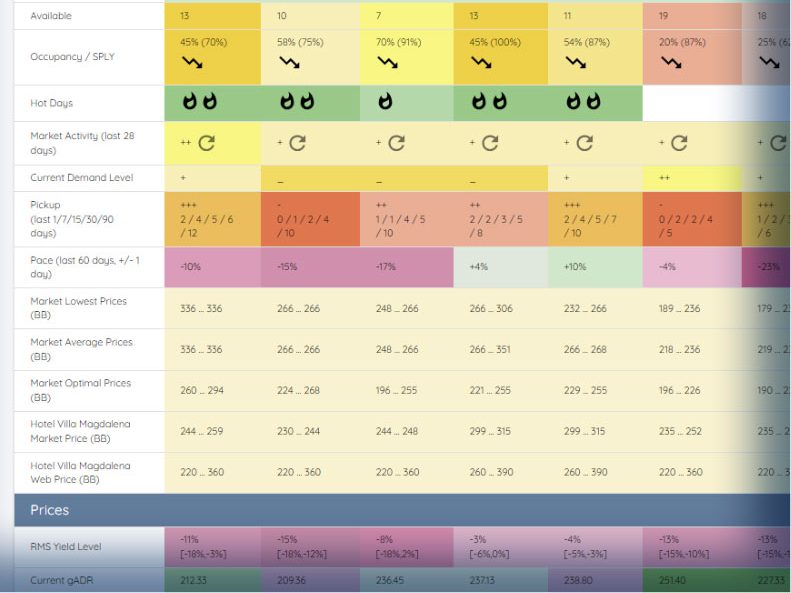
Another example could be a rule stating that the lowest-priced room category should remain slightly below the average price of comparable rooms in the target market.
This means that the hotel does not have to wait for someone to manually notice a market change. The price can respond to changes in demand as soon as they become visible in the data.
WebBookingPro Optimized Price
For users who want to take advantage of automation but do not want to define complex rules themselves, WebBookingPro offers the Optimized Price option.
It allows users to define a range within which the system optimizes the price according to relevant parameters, such as competitors, day of the week, and target occupancy.
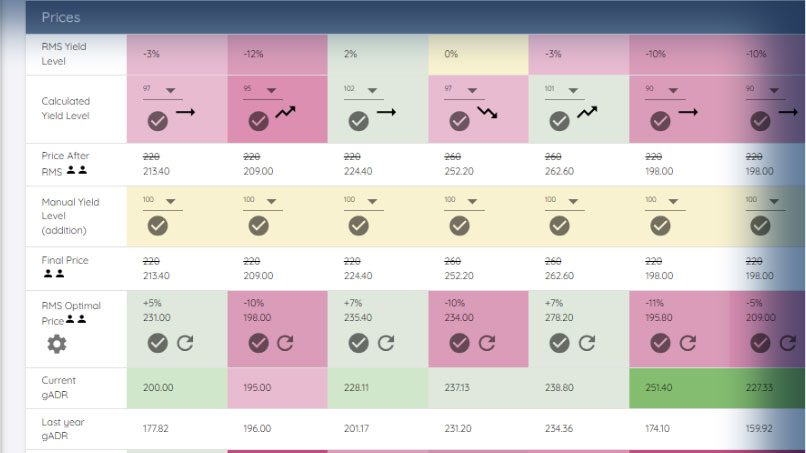
For example, a hotel can define that the price of a particular room can move within a range of -25% to +15% relative to the base price, while the system determines the optimal price for each individual day based on the available data and the defined strategy.
Is Manual Yielding Still Needed After Automation?
Yes, but only when necessary.
Automation does not mean losing control. After the system automatically adjusts prices once a day or even several times a day, the user can still additionally manually yield any specific date or room type.
Likewise, automation can be disabled for specific periods, individual dates, or particular room types.
This makes it possible to combine automation with human judgment: the system handles the routine work, while the user intervenes when there is a specific business reason to do so.
What About Competitor Rate Shopping?
An integral part of the WebBookingPro Revenue Manager is the Rate Shopper, which monitors the competitors selected by the hotel.
In addition to comparing current prices, it is possible to track how individual competitors’ prices change over time. This means that the hotel does not simply know who is “cheaper today”; it can analyze how competitors behave across different periods and how their pricing changes affect the market.
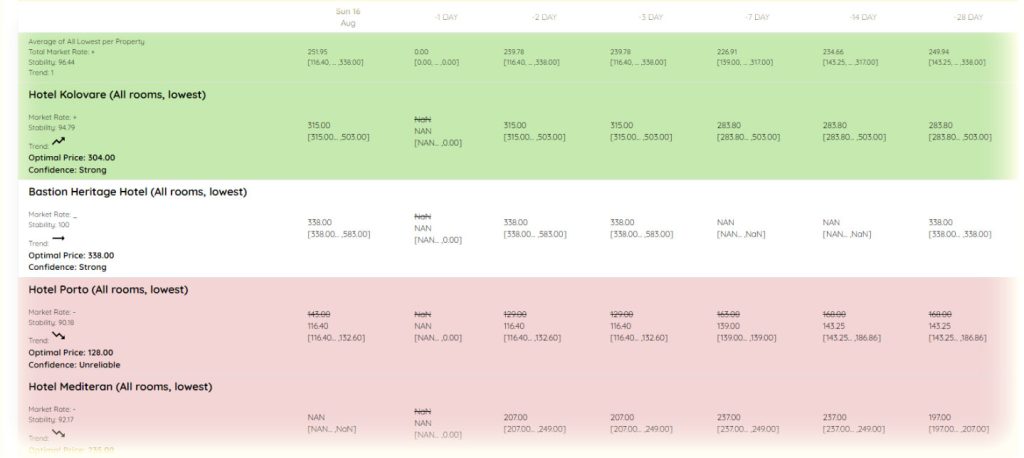
This is an important distinction because revenue management is not simply about comparing two prices at a single point in time. The goal is to understand market movements and respond proactively to changes in demand, competition, and the hotel’s own occupancy.
Automation as Support. Not a Replacement for the Revenue Manager
A Revenue Management system should not be viewed as a replacement for the person making business decisions. Its value lies in enabling those decisions to be made based on more data, faster, and with less manual work.
For large hotels, this means an additional level of automation and scalability. For small and medium-sized hotels, it can mean something even more important: the ability to apply advanced Revenue Management principles without the need for a large team or hours of daily manual analysis.
Which Revenue Management system is the best?
There is no single right answer.
Imagine four identical hotels, operating in exactly the same market, with the same demand, occupancy levels, and booking patterns. Now imagine that each hotel uses a different Revenue Management System (RMS), with four broadly similar pricing strategies.
In some cases, all four systems might recommend a similar or even exactly the same price. But in many situations, their recommendations will be different.
Why?
Every RMS uses its own algorithms, methodologies, and models to calculate the optimal or suggested price. The difference is not necessarily in the basic concept, but in how each system interprets the available data and translates it into a pricing decision.
One important factor is the amount and quality of data used in the calculation. More data can be valuable, but even more important is access to data that may not be visible or available to other systems. The broader and deeper the data set, the greater the potential for more informed pricing decisions.
More advanced RMS platforms also provide additional controls and rules. These can go beyond simply changing the price and include restrictions such as Minimum Length of Stay (MinLOS), Closed to Arrival (CTA), Closed to Departure (CTD), and other availability controls.
The difference can also be found in the level of reporting, analysis, and control a system provides. How easily can you analyze a particular date? Can you identify unusual booking patterns or anomalies? Can you understand why a price changed? How much control do you have over individual dates, room types, or periods? And how easily can you adjust the strategy when market conditions change?
All of these elements can ultimately influence the final pricing decision.
But there is one factor that is often underestimated: trust.
Integration
WebBookingPro Revenue Manager is integrated with several PMS systems, including Opera Cloud, Protel by Planet and Rentl.io, allowing relevant data to be used as the foundation for continuous price monitoring and optimization. It can be used as Stand alone solution or in connection with WebBookingPro CRS/Channel Manager.
Ultimately, the goal of Revenue Management is not simply to have a “higher price.”



The goal is to have the right price, for the right date, for the right room type, at the right time and to adjust it as soon as market conditions change.
That is where an automated Revenue Management system can deliver its greatest value: turning data into timely decisions and enabling a hotel to continuously adapt to the market, rather than reacting only when someone manually notices that something has changed.